
 Business License
Brass vs Stainless Steel vs Zinc Alloy: Metal Snap Button Materials Compared
A metal snap button material settles four questions at once: how much pull the closure takes before it deforms, how it behaves in humid air, how much it adds to the garment's weight, and what finishes are available on it. Brass, stainless steel and zinc alloy cover most garment orders, and the differences between them are measurable rather than a matter of taste.
This comparison puts the three side by side on the properties that drive real claims. It works through holding force, corrosion behaviour, forming route, weight and finishing, and it names the point at which a stainless steel snap fastener or a zinc alloy button stops being the sensible answer. Most material complaints arrive as a plating problem rather than a strength failure, so plating gets its own section.
1. What Metal Snap Button Material Choice Actually Decides
The table below is the short version of everything that follows. Each row is a property that can be specified, sampled and tested, which is what makes a metal snap button material decision auditable later.
| Property | Brass | Stainless steel | Zinc alloy |
|---|---|---|---|
| Forming route | Stamping | Stamping | Die casting |
| Density, roughly | 8.5 g/cm3 | 7.9 g/cm3 | 6.6 g/cm3 |
| Hardness in service | Medium, work hardens | High | Lower |
| Corrosion without a coating | Tarnishes | Resists | Poor |
| Plating normally required | Yes | No | Yes |
| Shape freedom | Good | Limited | Highest |
| Relative unit cost | Highest | Mid to high | Lowest at volume |
Two rows decide most outcomes. The forming route fixes both the cost curve and the shapes available, while the corrosion row decides whether the closure's life depends on a coating or on the alloy itself. Everything else in this article follows from those two, including the plating specification, the weight the closure adds and the failure mode a buyer should watch for during sampling.
2. Brass: The Baseline Metal Snap Button Material
Brass is the reference point for a metal snap button material, because the alloy has been used for closures long enough that tooling, plating lines and buyer expectations are all built around it.
Its strength is the combination of hardness and ductility. A brass body can be stamped into a thin, precise shell that holds a die-cut tolerance closely, and the alloy work-hardens as it forms, so part of the holding force comes from the forming operation rather than from the socket alone.
Its weakness is appearance under humidity. Unplated brass tarnishes, so a brass closure is almost always plated, which shifts the durability question from the metal to the coating. That is workable, but it means the plating specification carries more weight than the alloy choice does.
Difei Button (Guangzhou) keeps tooling for all three materials, so a buyer comparing them can receive brass, stainless steel and zinc alloy parts in the same shape rather than judging from photographs. Asking for that matched set at sampling removes most of the uncertainty from a metal snap button material decision.
3. Stainless Steel Snap Fastener: Where Corrosion Resistance Is the Point
A stainless steel snap fastener trades some cost and a good deal of forming freedom for corrosion resistance that does not depend on a coating.
Grade 304 covers most garment work, and the practical consequence is that a scratch does not turn into a rust mark, because the protection sits in the alloy rather than on the surface. That property matters on workwear, swimwear and anything put through industrial laundering.
The trade-off is forming. Stainless steel is harder to stamp than brass, so dies wear faster and deep profiles are more difficult to achieve, which narrows the range of shapes a stainless steel snap fastener can take. Where a design depends on deep relief or a sharp rim, the material choice usually has to move to zinc alloy instead.
Annealing and the final polish decide how consistent the surface reads across a batch. A well-finished stainless part has a slightly cooler tone than plated brass, which some buyers accept and others reject on sight, so a physical sample matters more here than a colour code.
4. Zinc Alloy Button: Die Casting, Cost and Limits
A zinc alloy button is produced by die casting rather than stamping, and that single difference explains most of its behaviour.
Die casting lets a zinc alloy button take a shape that would be awkward to stamp, including deep relief, complex rims and decorative edges with fine detail. The process is economical at volume, so once tooling is amortised a zinc alloy button usually carries the lowest unit price of the three.
The limits are mechanical rather than commercial. Zinc alloy is the softest of the three in service, it corrodes readily without a coating, and it responds to plating less predictably than brass does. For decorative closures and moderate loads the material performs well, while for a load-bearing closure on heavy fabric it is usually the wrong answer.
5. Holding Force: How Each Metal Snap Button Material Performs
Holding force depends on socket geometry and on the spring member as much as on the body, but the body sets the ceiling that geometry can work within. A soft body deforms before a hard one does, and deformation is what ends the closure's useful life.
The ranges below are planning figures for a 15 mm closure tested in line with the fastener. They are broad on purpose, because socket tolerance moves the result more than the alloy does.
| Metal snap button material | Planning pull range | Typical failure mode | Note |
|---|---|---|---|
| Brass | 60 - 90 N | Socket deformation | Closest tolerance control |
| Stainless steel | 65 - 95 N | Minimal deformation | Harder to fine-tune downward |
| Zinc alloy | 45 - 70 N | Body fracture at the rim | Adequate for lighter loads |
The upper end of a range is not automatically better. A closure that releases at 90 N suits a coat front and is unpleasant on a shirt placket, where the wearer expects the snap to open with light pressure. Choosing a metal snap button material for strength beyond the garment's requirement buys nothing the wearer can feel, and Difei runs the pull test on the assembled garment whenever the buyer can supply the fabric.
6. Corrosion and Plating: The Stainless Steel Snap Fastener Advantage
Corrosion is where the three separate most sharply, and neutral salt spray hours give a common yardstick. The comparison below assumes a 15 mm part tested to the appearance criteria the buyer sets.
| Material | Behaviour bare | Plated salt spray, roughly | Suits |
|---|---|---|---|
| Brass | Tarnishes over months | 24 - 72 hours nickel or brass | Dry climates, denim, jackets |
| Stainless steel | Resists without a coating | Not applicable | Coastal, marine, industrial wash |
| Zinc alloy | Corrodes quickly | 12 - 48 hours | Decorative trims, light duty |
Two details decide the real outcome on a plated closure. The first is barrier plating under the top coat, since a nickel or copper strike underneath stops a pin hole from becoming a corrosion site. The second is the plating thickness, which is far more useful to specify than the finish name.
A stainless steel snap fastener sidesteps both questions, which is why buyers sourcing for humid markets often accept the higher material cost and the narrower shape range. The saving shows up later as fewer finish claims rather than as a lower unit price.
Difei Button reports salt spray results on the finished plated part rather than on the raw coil, because plating quality decides that outcome while the base alloy does not.
7. Weight and Thickness: What Each Metal Snap Button Material Adds
Weight rarely decides a closure on its own, but it shows up in shipping cost and in how a light garment hangs once the closures are fitted.
Zinc alloy is the lightest of the three by volume, which is one reason die-cast closures are common on garments where the button is large but the fabric is light. Stainless steel sits just below brass in density, but it is usually run slightly thicker to keep stiffness, so the finished part often weighs about the same.
For a garment carrying fifteen to twenty closures, the difference between the heaviest and the lightest option typically comes to a few grams in total. That figure matters on a bulk knit and means nothing on a coat, so it is worth a quick calculation rather than an assumption.
A quick way to make that calculation is to weigh one closure of each candidate and multiply by the number the garment carries. On a fifteen-piece placket the spread usually falls under 10 g, which is invisible on outerwear and worth checking on a fine knit where any added weight shows in the drape. Thickness matters for a different reason: a thicker body can need a longer post or a deeper cap, which changes the tooling rather than just the weight.
8. Matching a Metal Snap Button Material to the End Market
The destination market narrows the choice faster than any other single input, because it fixes the humidity, the laundering method and the compliance requirements in one go.
The table below maps the common combinations onto a starting material. These are starting points for sampling, not rules, and a buyer with an unusual wash programme should test the assembled garment rather than the loose part.
| Market or use condition | Starting material | Reason |
|---|---|---|
| Coastal or salt air | Stainless steel | Protection does not depend on a coating |
| Industrial laundering | Stainless steel or plated brass | Survives repeated chemical cycles |
| Decorative, low load | Zinc alloy | Lowest cost at volume, most shape freedom |
| Denim and heavy cotton | Plated brass | Strength with a wide finish range |
| Nickel-restricted market | Plated brass, nickel-free route | Compliant plating without changing the body |
A childrenswear brand working with Difei Button (Guangzhou) Co Ltd once asked to move a line of closures from plated brass to zinc alloy to cut unit cost, and the sampling round showed the rims fracturing at the pull figure the garment needed. The line stayed on plated brass in a simpler finish, which closed most of the cost gap without changing the metal.
9. Frequently Asked Questions
9.1 Which metal snap button material is the strongest?
Stainless steel generally takes the highest pull before deforming, with brass close behind and zinc alloy clearly lower. The gap between stainless steel and brass is smaller than the gap between either of them and zinc alloy, so a buyer choosing between the first two is usually choosing on corrosion behaviour rather than on strength. Strength beyond what the garment needs brings no benefit, and an over-strong closure feels stiff to open on light fabric. Match the pull range to the fabric stack first, then use the corrosion requirement to pick the metal.
9.2 Is a stainless steel snap fastener worth the extra cost?
A stainless steel snap fastener earns its premium where humidity, salt air or industrial laundering would attack a plated surface, because the resistance comes from the alloy and cannot be scratched through. In a dry climate on a garment that is dry cleaned, plated brass usually performs well enough that the premium buys little. The honest test is a salt spray comparison on the finished part rather than on the raw material, since plating quality decides that outcome. Ask for both figures on the same test method before deciding.
9.3 When should I avoid a zinc alloy button?
Avoid a zinc alloy button wherever the closure carries a repeated load on heavy fabric, or wherever the part will sit in sustained humidity without a good coating. The material is the softest of the three and it fractures at the rim rather than deforming gradually, so failure arrives without warning. It is also the least predictable under plating, which makes finish claims more likely on a visible position. For decorative trims, light garments and moderate load it remains the most economical route.
9.4 Can brass and stainless steel parts be mixed in one garment?
They can be mixed, and the risk is galvanic rather than mechanical. When two different metals sit in contact in the presence of moisture, the less noble one corrodes faster than it would alone, which is why a stainless stud against a brass socket deserves a wet test rather than an assumption. In a dry garment the effect is negligible. Many trim packages do mix metals successfully, but the pairing should be confirmed on the assembled part with the buyer's own wash or wear conditions.
Recently Posted
-
Snap Buttons for Bags, Luggage and Leather Goods
September 22, 2026A bag snap button works under a load pattern that clothing never produces. A closure on a garment faces a pull along the fabric pl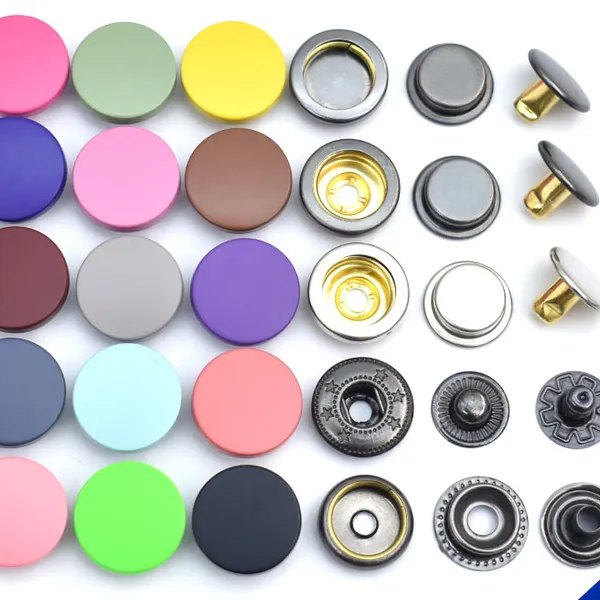 Read More
 -
Snap Button Size Chart: Common Diameters and Fabric Limits
September 22, 2026A snap button size chart answers one question well and several badly if it is read too quickly: which diameter belongs on which fa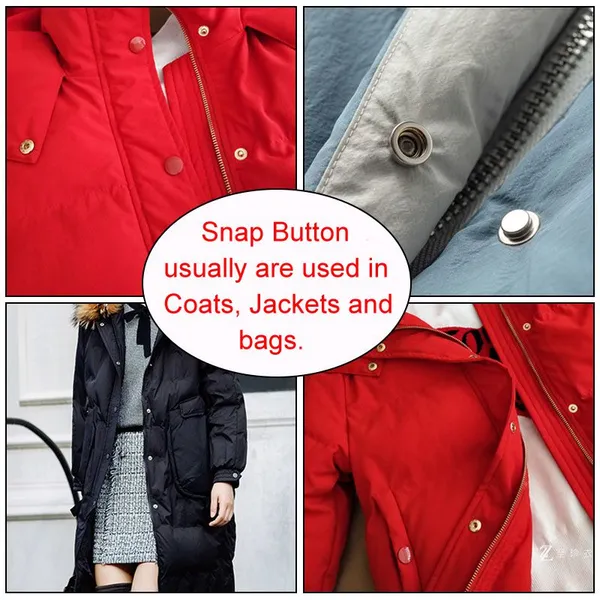 Read More
 -
Custom Snap Buttons with Your Logo: Tooling and Approval Workflow
September 22, 2026A custom snap button is a standard closure carrying the buyer's own mark, and nearly all of the work sits in the tooling and the a
Read More -
What Is a Shank Button? Construction, Types and Sewing Applications
September 22, 2026A shank button sits on a raised stem instead of lying flat against the cloth, and that single detail decides where it belongs. The Read More

Contact Us
Recommended Products
-
 Clothing Accessories Lead Free Brass Metal Ring Prong Snap Button With 4 Parts for Infant Baby Clothes Baby BibsUS$ 0.01 - 0.03MOQ: 5000 Sets
 -
Brass Metal Stainless Steel Material Ring Prong Snap Button With 4 Parts Lead Free & Nickel Free for Infant Baby Clothes Baby Bibs Baby SuitsUS$ 0.01 - 0.03MOQ: 5000 Sets
-
Metal Grommets Eyelets Gold Eyelet for Bag Shoes and Garment AccessoriesUS$ 0.01 - 0.03MOQ: 5000 Sets
-
Cheap Price Custom Jeans Button Metal Custom Logo Metal Button for JeansUS$ 0.01 - 0.03MOQ: 5000 Sets
-
Factory Wholesale Hat Bag Clothing Press Snap Button Spring Snap Button Metal Snap ButtonsUS$ 0.03 - 0.06MOQ: 5000 Sets
-
Wholesale Plastic Round Coloured Snaps Button Press Fasteners for Baby Bibs/ Baby GarmentsUS$ 0.01 - 0.03MOQ: 50000 Sets
-
Custom EngravedCopper I Brass Metal Jeans Button Denim Clothes Jacket for Jeans DenimUS$ 0.01 - 0.03MOQ: 5000 Sets
-
17mm Open Hole Shank Button With Aluminum Nail With Logo for Jeans Jacket PantsUS$ 0.01 - 0.03MOQ: 5000 Sets
-
Eco-friendly Custom Size Plastic Snaps Plastic Snap Button for Baby Clothes, Baby BibsUS$ 0.01 - 0.03MOQ: 50000 Sets
-
12mm 15mm 17mm 20mm Four Parts Metal Brass Fastener Press Snap Button for Clothes JacketUS$ 0.03 - 0.06MOQ: 5000 Sets
-
Custom Logo Personalized High Quality Metal Press Snap Fastener Snap Buttons for Clothing Garments JacketUS$ 0.03 - 0.06MOQ: 5000 Sets
-
Custom Printing Round Press Spring Four Part Snap Button for Clothing Leather 405#17mmUS$ 0.03 - 0.06MOQ: 5000 Sets
-
OEM Garment Accessories Custom Baby Snap Button Press Metal Prong Pearl Ring Snap ButtonUS$ 0.01 - 0.03MOQ: 5000 Sets
-
Factory Stock Buttons Stainless Steel or Brass Material Colors Pearl Snap Button Prong Pearl Snap Button for Shirts ClothingUS$ 0.01 - 0.03MOQ: 5000 Sets
-
Durable 9mm POM Four Part Plastic Snap Buttons Lead Nickel Free Safe Fasteners for Baby Bibs and Children ApparelNegotiableMOQ: 50000 Sets
-
Plastic Snap Fasteners 9mm POM Lead Nickel Free Hardware for Baby Bibs Children Apparel Sewing ProjectsNegotiableMOQ: 50000 Sets
-
Four Part Plastic Snap Buttons 9mm POM, Custom Color OEM ODM for Apparel and Bed SheetsNegotiableMOQ: 50000 Sets
-
Automatic Feeding Compatible Four Part Plastic Snap Buttons for High-speed AssemblyNegotiableMOQ: 50000 Sets
-
Resin Snap Buttons 9mm POM Eco Friendly Garment Closures for Bed Sheets Outerwear Infant TextilesNegotiableMOQ: 50000 Sets
-
Eco‑friendly POM Made Four Part Plastic Snap Buttons 9mm Garment Snaps for Infant Textile ManufacturingNegotiableMOQ: 50000 Sets