
 Business License
Snap Button Anatomy: Cap, Socket, Stud and Post Explained
Ask five suppliers to name the snap button parts on a single card and you will collect five different vocabularies for hardware that is physically identical. A four part snap fastener is genuinely four separate pieces, and each one carries a distinct job that decides how the assembled closure behaves. Buyers who learn the four names stop receiving the wrong goods, and factories spend less time recutting a die because a dimension was described in words rather than specified in numbers.
This guide takes the parts one at a time, explains how socket and stud engage, sets out the constructions used across the trade, and closes with the dimensions worth confirming on a drawing before any tool is cut.
1. Snap Button Parts: The Four Components and What Each One Does
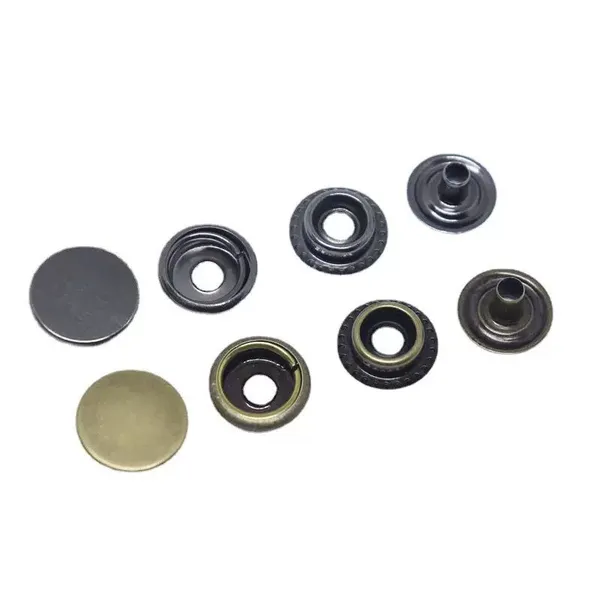
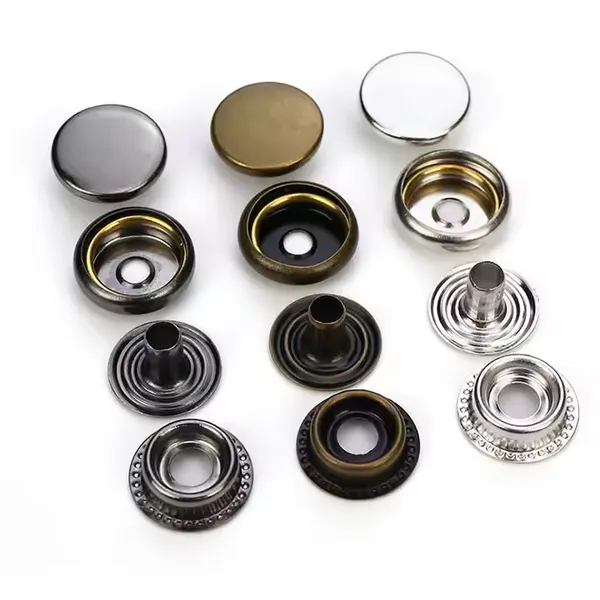
A four part snap fastener carries a cap, a socket, a stud and a post. Cap and socket form the upper half that the wearer sees and presses, while stud and post form the lower half that carries the spring and absorbs the pull. Once both halves are set into fabric and pressed together, the assembly reads as one small metal disc about 10 mm to 22 mm across.
The naming trap sits in the cap. Some factories call it a cap, others call it a ring, and a few call it the female cap because the socket is pressed into it. The physical object does not change, but a purchase order written with the wrong noun can produce a shipment that fits nothing on the line.
The four pieces differ in material and in where they sit, and the division of labour between them is worth setting out plainly.
| Part | Position | Function | Typical material |
|---|---|---|---|
| Cap | Upper half, visible face | Covers the socket and carries the decorative finish | Brass, stainless steel, zinc alloy, POM |
| Socket | Upper half, pressed into the cap | Holds the split spring that grips the stud | Brass, stainless steel |
| Stud | Lower half, visible on the inner face | Carries the bead that enters the socket | Brass, stainless steel, POM |
| Post | Lower half, passes through fabric | Forms the tube that is rolled to fix the half | Brass, stainless steel |
2. Socket and Stud: How the Two Halves Meet and Release
The socket holds a split spring, usually a small ring of hardened wire or a pressed metal collar, that narrows at its mouth. The stud carries a rounded bead whose diameter is slightly larger than that opening. Pressing the halves together forces the bead through the narrow section, the spring opens, and once the bead passes the constriction the spring closes behind it.
Release works in reverse and depends on spring tension rather than on a locking mechanism. Pulling the halves apart pushes the spring open again, which is why the separating force stays roughly constant over the working life of the closure. A spring that has fatigued after several thousand cycles opens under a lighter pull, and that change is the one a wearer notices first.
The engagement is measured in tenths of a millimetre, so the fit between socket and stud is a matter of tooling rather than of assembly skill. Two sockets cut from the same die behave the same way on the line, and two from different dies may not. That is why the socket and stud pair is quoted together on a drawing rather than as two independent items.
3. The Cap and the Post in a Snap Button Assembly
The cap is the appearance part and takes the finish the buyer specified, whether that is nickel, antique brass, black oxide or a painted colour. The post is the structural part on the lower half, a tube that passes through the fabric and is rolled outward to clamp the assembly in place. A post that is too short will not roll far enough to grip, and one that is too long will stand proud of the fabric and catch on skin.
For a snap button assembly the post length is written against the thickness of the material stack rather than against the button diameter, because two garments can share a diameter and still need different posts. A 12 mm closure in a single layer of shirting needs a shorter post than the same closure through a bonded placket with an interlining.
Cap height deserves the same attention and is often left off a drawing altogether. A tall cap suits a coat front where the closure is part of the design, while a low cap sits flush under a placket and disappears into the garment line.
4. How a Four Part Snap Fastener Locks and Releases
A four part snap fastener behaves predictably because three dimensions govern it. The depth of the recess inside the socket sets how far the stud travels before it engages. The spring opening sets the release force. The bead diameter on the stud sets how firmly the spring has to open to accept it.
Small changes in those three dimensions show up as a change in feel rather than as a visible fault, which is why closure force is measured rather than inspected by eye. A factory that adjusts the spring opening by roughly 0.1 mm can move the release force by several newtons without touching any other part of the assembly.
The relationship also explains why a closure can pass a fresh test and fail in service. A spring sitting at the wide edge of its band releases at the low end of the specification, and after a few thousand openings it moves below it. Testing a part as produced and testing the same part after cycling give two different answers, and both figures belong on a specification.
5. Two Part, Three Part and Four Part Constructions Compared
The four part construction is the most common in garment trim because each piece can be finished separately and replaced on its own. A three part version moulds the socket and stud as single pieces, which suits plastic closures where the spring is formed in the same shot as the body. A two part version fuses the cap and post into one pressing that is crimped rather than rolled.
Choosing between them is a question of volume and appearance rather than of strength alone. The four part route offers the widest finish range and the simplest repair, because a damaged cap can be swapped without replacing the socket behind it. The two part route sets faster on a line because there are fewer pieces to feed into the press, which matters at volumes above a few hundred thousand pieces.
The table below sets the three constructions side by side against the criteria that usually decide the choice.
| Construction | Pieces | Suits | Watch for |
|---|---|---|---|
| Four part | 4 | Metal trim, plackets, bags | More pieces to kit and feed |
| Three part | 3 | Plastic closures, sportswear | Narrower finish range |
| Two part | 2 | High volume light trim | No independent replacement |
6. Snap Button Parts Tolerances and How They Mesh
Tolerances decide whether parts from two production runs will work together, and they matter more than the nominal size on the drawing. A socket cut to a band of roughly plus or minus 0.05 mm on its inner diameter will accept a stud from a matched run about 99 times in 100. The same socket from a run that drifted to the wide edge of its band will still fit a fresh stud but loosen sooner.
Dimensional chains accumulate, so a part held at the centre of its tolerance band buys room for the parts around it. A factory that manages cost by widening tolerances will pass a first article inspection and still generate a field complaint months later, because the failure is gradual rather than immediate.
Difei Button holds a die record and a sealed first article for each set of snap button parts, which gives a repeat order a reference to measure against rather than a fresh argument to settle.
A childrenswear brand working with Difei Button (Guangzhou) once received a shipment in which the caps and sockets came from two separate production runs. Each part matched its own drawing and both sat within tolerance on the nominal figures. The assembled closures released at roughly 18 N instead of the 35 N the garment had been approved at, because the socket ran to the wide edge while the stud bead ran to the narrow edge.
The fix was to specify a tolerance band rather than a nominal and to hold both parts to the centre of that band on the next order. Nothing about the metal or the finish had to change.
7. Drawing a Snap Button Part: Dimensions to Confirm
A drawing for a snap button part is worth little unless six figures appear on it, and that holds for a snap button parts order of any volume. Nominals are not sufficient on their own, because a nominally correct part can sit anywhere inside its band. Writing the target and the limits together removes the argument about whether a shipment conforms.
The six figures below cover the dimensions that decide both appearance and function.
| Figure | Why it matters |
|---|---|
| Cap outer diameter | Decides the visual footprint and the flange width |
| Cap height | Sets how far the assembly stands off the fabric |
| Socket inner diameter | Sets the release force of the closure |
| Stud bead diameter | Sets how firmly the spring grips |
| Post length | Must match the thickness of the material stack |
| Post wall thickness | Decides how the roll forms and how it resists pull |
Three of the six cause most of the trouble in practice. Post length and cap height are quoted from different reference points by different suppliers, so a drawing has to state which surface the measurement starts from. Post wall thickness is often omitted entirely, which leaves the strength of the roll to chance.
Difei Button (Guangzhou) Co Ltd writes those six figures together with their limits onto every part drawing, and keeps the drawing attached to the purchase order so a second run matches without a fresh negotiation.
8. Which Snap Button Parts Suit Which Garment Position
Part choice follows the position on the garment and the load it will see. A shirt placket takes a small cap and a thin post because the fabric is light and the closure carries almost no load. A jacket front takes a larger cap and a heavier spring because the wearer opens it against a stiffer panel.
Bag flaps and workwear fronts sit at the heavy end, where a wider flange and a reinforced post keep the panel from tearing around the fixing. Babywear sits at the opposite extreme and needs a smooth rolled edge with no exposed sharp rim. Difei Button (Guangzhou) matches the part set to the position during sampling, so the same diameter is not reused blindly across a whole range.
| Position | Cap diameter | Post | Priority |
|---|---|---|---|
| Shirt placket | 10 - 12 mm | Thin | Low profile under a button stand |
| Blouse, light knitwear | 8 - 10 mm | Thin and short | Fabric protection |
| Jacket front | 15 - 18 mm | Standard | Secure hold on a stiff panel |
| Bag flap, strap anchor | 18 - 22 mm | Heavy, wide flange | Load spreading |
| Childrenswear | 8 - 12 mm | Standard, smooth roll | Rounded edge |
A bag maker made the opposite mistake on a strap anchor, where a long post chosen for a thick panel was reused on a thinner lining. The roll stood proud of the fabric and caught on the wearer's clothing until the post was shortened by about 1.5 mm.
9. Frequently Asked Questions
9.1 What are the four parts of a snap button?
Snap button parts are a cap, a socket, a stud and a post. The cap and socket form the upper half that the wearer presses, and the stud and post form the lower half that carries the spring and passes through the fabric. A four part snap fastener is the most common construction in garment trim because each piece can be replaced on its own. Confirming the four names on a drawing avoids the usual mix-up, which is calling the cap a ring.
9.2 How do socket and stud stay together?
The socket contains a split spring that narrows at its mouth, and the stud carries a bead slightly wider than that opening. Pressing the halves together forces the spring apart, and it closes behind the bead to lock the assembly. Release force comes from spring tension, so the closure holds until the wearer pulls the halves apart. A fresh closure typically releases somewhere between 25 N and 60 N depending on size, and the figure drifts downward as the spring fatigues over a long service life.
9.3 Does the number of parts change how strong the closure is?
Strength comes from the spring and the post rather than from the number of pieces. A well-made two part closure can hold more than a poorly made four part one, because release force depends on the spring opening and grip depends on the roll. What the four part construction buys is a wider finish range and easier replacement at repair. Buyers comparing constructions should ask for the release force and the post dimensions on a drawing rather than counting parts.
9.4 Which dimensions should I put on a purchase order?
Write the cap outer diameter and height, the socket inner diameter, the stud bead diameter, and both the post length and wall thickness. Adding a tolerance band to each figure is more useful than adding a picture, because it tells the factory what variation will be accepted. State the reference surface for the post length and the cap height, since suppliers measure those from different points on the part. A drawing carrying those six figures and their limits prevents most first-article arguments.
Recently Posted
-
Snap Buttons for Knitwear and Lightweight Fabrics
September 24, 2026Choosing a knitwear snap button is a different exercise from specifying one for a woven shirt, because the material around the fix Read More
 -
Oeko-Tex Standard 100 and Button Compliance: What to Verify
September 24, 2026Compliance questions arrive late in most trim orders, usually after a garment buyer has been asked for a certificate that nobody o
Read More -
Packaging, Carton Configuration and Shipping Terms for Button Orders
September 24, 2026A button order is small in value and heavy in handling, which makes button packaging the part of the transaction that most often p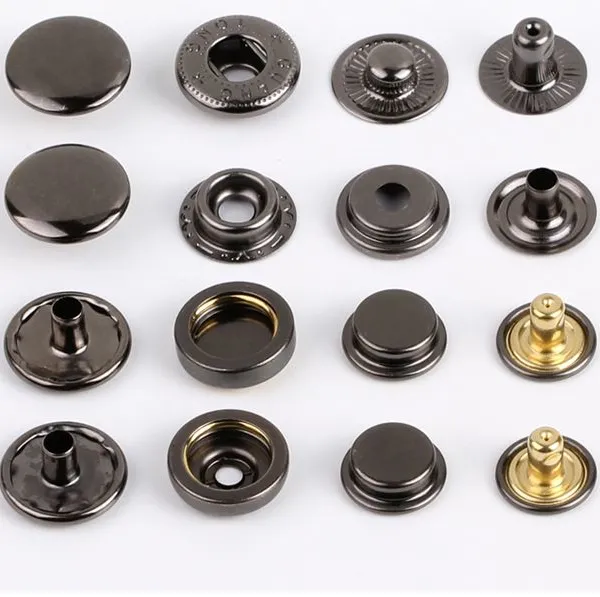 Read More
 -
Plating and Coating Options for Metal Snap Buttons
September 24, 2026Two orders can use identical brass underneath and behave completely differently after a year of wear, because the snap button surf Read More

Contact Us
Recommended Products
-
 Clothing Accessories Lead Free Brass Metal Ring Prong Snap Button With 4 Parts for Infant Baby Clothes Baby BibsUS$ 0.01 - 0.03MOQ: 5000 Sets
 -
Brass Metal Stainless Steel Material Ring Prong Snap Button With 4 Parts Lead Free & Nickel Free for Infant Baby Clothes Baby Bibs Baby SuitsUS$ 0.01 - 0.03MOQ: 5000 Sets
-
Metal Grommets Eyelets Gold Eyelet for Bag Shoes and Garment AccessoriesUS$ 0.01 - 0.03MOQ: 5000 Sets
-
Cheap Price Custom Jeans Button Metal Custom Logo Metal Button for JeansUS$ 0.01 - 0.03MOQ: 5000 Sets
-
Factory Wholesale Hat Bag Clothing Press Snap Button Spring Snap Button Metal Snap ButtonsUS$ 0.03 - 0.06MOQ: 5000 Sets
-
Wholesale Plastic Round Coloured Snaps Button Press Fasteners for Baby Bibs/ Baby GarmentsUS$ 0.01 - 0.03MOQ: 50000 Sets
-
Custom EngravedCopper I Brass Metal Jeans Button Denim Clothes Jacket for Jeans DenimUS$ 0.01 - 0.03MOQ: 5000 Sets
-
17mm Open Hole Shank Button With Aluminum Nail With Logo for Jeans Jacket PantsUS$ 0.01 - 0.03MOQ: 5000 Sets
-
Eco-friendly Custom Size Plastic Snaps Plastic Snap Button for Baby Clothes, Baby BibsUS$ 0.01 - 0.03MOQ: 50000 Sets
-
12mm 15mm 17mm 20mm Four Parts Metal Brass Fastener Press Snap Button for Clothes JacketUS$ 0.03 - 0.06MOQ: 5000 Sets
-
Custom Logo Personalized High Quality Metal Press Snap Fastener Snap Buttons for Clothing Garments JacketUS$ 0.03 - 0.06MOQ: 5000 Sets
-
Custom Printing Round Press Spring Four Part Snap Button for Clothing Leather 405#17mmUS$ 0.03 - 0.06MOQ: 5000 Sets
-
OEM Garment Accessories Custom Baby Snap Button Press Metal Prong Pearl Ring Snap ButtonUS$ 0.01 - 0.03MOQ: 5000 Sets
-
Factory Stock Buttons Stainless Steel or Brass Material Colors Pearl Snap Button Prong Pearl Snap Button for Shirts ClothingUS$ 0.01 - 0.03MOQ: 5000 Sets
-
13.8mm x 7.5mm Plastic Grommet Kit for Apparel and Garment Lacing, Lightweight and FlexibleNegotiableMOQ: 5000 Sets
-
Clear Plastic Eyelet and Washer Set Two‑piece Fastener for Tote Bags Canvas and Fabric Hole Reinforcement ApplicationsNegotiableMOQ: 5000 Sets
-
13.8mm x 7.5mm Clear Plastic Eyelet and Washer Set Durable Two‑part Hardware for Fabric Reinforcement and Bag Making ApplicationsNegotiableMOQ: 5000 Sets
-
Two‑Piece Plastic Grommet and Washer Set 13.8mm x 7.5mm Clear Hardware for Banner Craft Works and Light‑weight Textile ProductionNegotiableMOQ: 5000 Sets
-
Clear Plastic Eyelet and Washer Set 13.8mm x 7.5mm for Tarps, Banners, and Awning Fabric ReinforcementNegotiableMOQ: 5000 Sets
-
Clear Plastic Eyelet and Washer Set Snap‑together Grommet Assembly Suited for Sewing Accessory and Finished Bag ManufacturingNegotiableMOQ: 5000 Sets