
 Business License
Pearl Snap Buttons: How Decorative Snap Fasteners Are Made and Used
A pearl snap button is a decorative closure whose visible face carries a rounded, glass-like dome rather than a plain metal disc. The dome is moulded from resin or POM, or pressed as a metal cap with a decorative pattern, and it sits over the same socket and stud mechanism that any other snap fastener uses. Buyers meet the term most often on western shirts, where the closure reads as part of the garment identity instead of a hidden fixing. This guide explains how the domed top is made, how sizing works on a pearl button for shirts, and what to confirm before a production order is placed.
The sections move from parts and materials through the finishing process, then into sizing, attachment and the quality checks that decide whether a shipment stays consistent from the first carton to the last.
1. What a Pearl Snap Button Is and Where the Term Comes From
A pearl snap button takes its name from the domed top, which was first made to imitate a mother-of-pearl button. The early versions appeared on western shirts and workwear, where a bright face read well against dark denim and heavy twill. Real shell was too brittle for a garment that would be washed every week, so makers turned to resin and to pressed metal that could hold the same sheen. The imitated dome kept the look and dropped the fragility, which is why the style outlived the material it copied.
The naming stays loose in the trade. Some factories use the term to mean any domed decorative closure, while others reserve it for a resin top moulded in a pearl colourway. A buyer who needs a specific look is safer describing the dome material and the finish code than relying on the noun alone. Requesting a sample against a written finish description removes most of the ambiguity before an order is placed.
The mechanism underneath does not change with the decoration. Every pearl snap button carries a cap, a socket, a stud and a post, and the closing force comes from the spring inside the socket. Decoration sits on top of that assembly and never replaces it.
2. Pearl Button for Shirts: Size, Finish and Placement
A pearl button for shirts is usually chosen in a diameter between 12 mm and 18 mm, which is larger than the plain snap on a casual garment. The extra size comes from the visual job the closure does, since the domed face is meant to be seen rather than concealed under a placket. Smaller domes of 10 mm to 12 mm suit childrenswear and slim blouses, while 16 mm and above suits a heavy western yoke.
| Diameter | Typical garment | Dome height | Notes |
|---|---|---|---|
| 10 - 12 mm | Childrenswear, slim blouse | 3 - 4 mm | Light fabric, thin post |
| 13 - 15 mm | Western shirt, casual shirt | 4 - 5 mm | Standard placket width |
| 16 - 18 mm | Heavy workwear shirt | 5 - 6 mm | Reinforced facing advised |
| 19 - 22 mm | Coat and jacket front | 6 - 8 mm | Decorative statement size |
Placement follows the placket spacing that the pattern already sets, and the dome adds roughly 3 mm to 8 mm of height above the fabric. That height matters on a fitted garment, because a tall dome pressed against a seat belt or a bag strap can lever open under load. Checking dome height against the way the garment will be worn avoids a complaint that the closure releases under sideways pressure.
Finish choices divide into a pearl colour that imitates shell, a solid colour matched to the fabric, and a metal cap with a painted or plated face. Difei Button keeps the dome height and the finish code on the same sample card, so a repeat order matches without a fresh round of photographs.
3. Western Pearl Snap: How a Costume Detail Became Standard
A western pearl snap earns its place on the garment for reasons that have little to do with closure strength. The domed face catches light across a yoke, and the size is large enough to read from a distance, which suits a shirt worn open. Riders who needed to open a shirt with cold or gloved hands also benefited from a closure that separates with a firm pull rather than a small button, and that practical argument kept the detail in place after the style moved into everyday wear.
Modern versions sit at the meeting point of costume and function. A 15 mm dome with an antique brass rim reads as traditional, while a coloured resin dome with a matte finish reads as contemporary. Both use the same socket and stud behind the face, so the difference is one of appearance rather than of mechanism.
For a brand building a range, the western pearl snap offers a way to vary a shirt without cutting a new pattern. Changing the dome colour or the rim finish changes the read of the garment while the placket spacing and the fixing position stay exactly as they were.
4. How a Pearl Snap Button Is Assembled
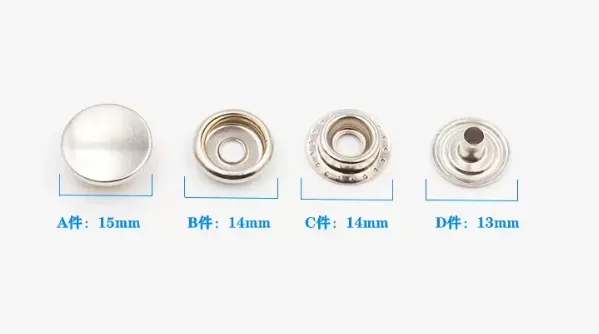
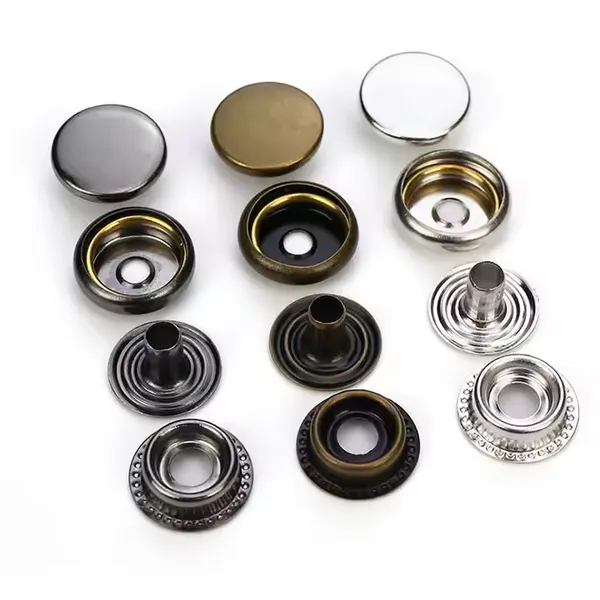
Assembly follows the same four part sequence as any snap fastener, with the dome added to the cap. The socket is pressed into the cap from behind, the stud and post form the lower half, and a setting die rolls the post to clamp the assembly through the fabric. On a decorated closure the cap carries the visible face, so the same die has to seat a dome that is taller than a flat cap.
| Part | Job in a pearl snap | Material options |
|---|---|---|
| Dome | Carries the visible pearl or painted face | Resin, POM, plated metal |
| Cap | Holds the dome and the socket together | Brass, stainless steel, zinc alloy |
| Socket | Holds the split spring that grips the stud | Brass, stainless steel |
| Stud | Carries the bead that enters the socket | Brass, stainless steel, POM |
| Post | Passes through fabric and is rolled to fix | Brass, stainless steel |
A taller dome changes the setting more than most buyers expect. The die has to hold the cap steady without crushing the dome, and the press stroke has to be set so the roll forms fully without cracking the resin above it. A dome that is 6 mm tall needs a different setting height from a 3 mm dome even when the cap diameter is identical.
Difei Button (Guangzhou) Co Ltd sets the press stroke against the dome height and the material stack together on the first sample, and records the setting so a repeat run starts from a known point rather than from a fresh guess.
5. How a Pearl Snap Button Top Gets Its Finish
The finish on a pearl snap button top is created in three main ways, and each leaves a different surface. Moulded resin is cast in a pearl or coloured compound and comes out with a smooth, slightly translucent face. A painted metal cap is stamped, plated and then sprayed or dipped in colour. A plated cap is finished with nickel, antique brass, black oxide or a similar coating that leaves the metal visible.
Consistency is the harder problem. Two resin domes from the same mould can differ if the compound is not mixed to the same ratio, and the difference shows as a colour shift across a placket. Plating baths drift as they are used, so a cap plated at the start of a shift can sit a shade away from one plated at the end. Buyers who care about a visible row of closures should ask for a colour band rather than a single approved sample.
The finish also decides how the dome behaves in service. A high-gloss resin face picks up fine scratches, while a matte finish hides them. A plated cap resists wear at the rim but can chip if the coating is thin, and a chipped rim on a decorative face is far more noticeable than the same damage on a hidden fixing. A coating of 0.3 micron to 0.5 micron is enough for a decorative part, while a plated rim that takes daily contact usually wants 1 micron or more.
6. Choosing a Pearl Button for Shirts by Fabric Weight
Fabric weight decides the post length, and post length is where most complaints about this closure start. A shirt in a light poplin of around 110 gsm needs a short post, while a heavy denim shirt of 350 gsm or more needs a longer one. Using a heavy post on light fabric leaves the roll standing proud of the surface, and using a short post on heavy fabric produces a loose fixing that turns in the panel.
| Fabric | Weight range | Post length | Cap size |
|---|---|---|---|
| Shirting poplin | 100 - 140 gsm | 5 - 6 mm | 12 - 14 mm |
| Oxford cotton | 140 - 200 gsm | 6 - 7 mm | 13 - 15 mm |
| Denim shirt | 250 - 350 gsm | 7 - 8 mm | 15 - 17 mm |
| Heavy workwear denim | 350 gsm and above | 8 - 10 mm | 16 - 18 mm |
The facing behind the placket matters as much as the fabric itself. A western shirt usually carries a doubled placket or an interlining, and that extra layer changes the effective stack thickness by 1 mm to 2 mm. Measuring the stack where the closure will sit, rather than measuring the fabric alone, gives a post length that fits on the line.
Difei Button (Guangzhou) matches the post to the measured stack during sampling rather than quoting from a stock table, which avoids a repeat shipment that fits the fabric but not the placket.
7. Western Pearl Snap Sizing and Facing Reinforcement
Sizing on a western pearl snap is driven by the yoke and the placket rather than by the wearer. A standard placket carries a 15 mm dome spaced at 65 mm to 75 mm centres, which gives a rhythm that reads evenly across the front. Narrower spacing crowds the domes and hides the spacing inside the fabric fold, while wider spacing leaves the placket open between closures.
Reinforcement protects the fabric around the fixing. Denim and heavy twill resist tearing at the post on their own, but a lightened or washed fabric benefits from a small facing patch behind each position. The patch spreads the load over a wider area and keeps the post from working a hole through a thin panel over a season of wear.
A brand that skipped the facing on a washed cotton shirt saw the placket tear at three positions after about 20 washes. Adding a 20 mm facing patch behind each closure resolved it without changing the dome size or the placket spacing.
8. Pearl Snap Button Quality Checks Before Mass Production
Quality checks on a decorated snap cover appearance, function and fit, and all three need a written target before the first carton is made. Appearance is verified against the approved sample under a stated light source, because a pearl finish that matches in daylight can read differently under a shop spotlight. Function is measured as release force in newtons, and fit is verified against the fabric stack the closure was specified for.
| Check | Method | Target |
|---|---|---|
| Colour match | Visual against approved sample under D65 light | Within the agreed colour band |
| Release force | Pull test on 10 pieces per batch | 25 - 60 N depending on size |
| Dome height | Micrometer on 10 pieces per batch | Within plus or minus 0.2 mm |
| Roll integrity | Visual and manual pull after setting | No crack, no rotation in fabric |
| Post engagement | Section cut on 3 pieces per batch | Full roll, no gap at the shoulder |
Sampling and production have to be measured the same way, or the two sets of numbers cannot be compared. A factory that measures release force with a hand gauge at sampling and a bench rig in production will report two different figures for the same part, and the difference sits in the method rather than in the goods.
Difei Button (Guangzhou) Co Ltd keeps the inspection method on the same sheet as the specification, so a buyer reading a report knows how each figure was produced and can repeat the test at goods-in.
9. Frequently Asked Questions
9.1 What is the difference between a pearl snap button and a plain snap button?
The difference sits in the visible face rather than in the mechanism. A plain snap shows a metal cap, while a decorated version carries a domed top that imitates shell or adds a colour, and that dome is moulded from resin or pressed as a metal cap. Both versions use the same socket, stud and post underneath, so the closing force comes from the same spring. The decorated closure is usually made in a larger diameter because the face is meant to be seen.
9.2 How do I choose a pearl button for shirts?
Start with the diameter that suits the garment, using 12 mm to 14 mm for a light shirt and 15 mm to 18 mm for a western style with a heavy placket. Then measure the fabric stack where the closure will sit, including any facing or interlining, and specify a post length that matches that measurement rather than the fabric alone. Finish comes last, and it is worth approving a colour band instead of a single sample when the closure sits in a visible row.
9.3 Why do western pearl snaps use larger domes?
The larger dome is a design decision that suits the way the garment is worn and read. A dome of 15 mm or more catches light across a yoke and stays visible when the shirt is worn open, which matters on a garment where the closure is part of the styling. The size also suits a firm pull with cold or gloved hands, since a wide face is easier to grip than a small button. Decoration does not change the closing force, which is set by the spring inside the socket.
9.4 What should I inspect before accepting a shipment of decorative snaps?
Check colour against the approved sample under a stated light source, measure the dome height on a sample of pieces, and run a release force test on the batch. Confirm that the post roll is complete on a sectioned piece, since a partial roll can pass a visual check and still pull loose in washing. Ask for the inspection method to be written on the report, because a figure without a method cannot be compared with the sample figures you approved earlier.
Recently Posted
-
Buttons for Bedding, Pillow Covers and Home Textiles
September 28, 2026A home textile button lives a harder life than a garment closure, because it is unfastened to wash and refastened when the item go Read More
 -
Specifying Button Tolerances on a Purchase Order
September 28, 2026Two shipments can both match the drawing and still fail to work together, because a nominal figure says nothing about where inside Read More
 -
Ordering Custom Badges: Tooling, Backing and Approval Steps
September 28, 2026A custom metal badge order fails for one of three reasons, and none of them is the price of the metal. The artwork is approved bef Read More
 -
Shank Button vs Flat Button: Matching Construction to Garment Weight
September 28, 2026The shank button vs flat button decision looks like a styling question and behaves like a structural one, because the two parts ha Read More

Contact Us
Recommended Products
-
 Clothing Accessories Lead Free Brass Metal Ring Prong Snap Button With 4 Parts for Infant Baby Clothes Baby BibsUS$ 0.01 - 0.03MOQ: 5000 Sets
 -
Brass Metal Stainless Steel Material Ring Prong Snap Button With 4 Parts Lead Free & Nickel Free for Infant Baby Clothes Baby Bibs Baby SuitsUS$ 0.01 - 0.03MOQ: 5000 Sets
-
Metal Grommets Eyelets Gold Eyelet for Bag Shoes and Garment AccessoriesUS$ 0.01 - 0.03MOQ: 5000 Sets
-
Cheap Price Custom Jeans Button Metal Custom Logo Metal Button for JeansUS$ 0.01 - 0.03MOQ: 5000 Sets
-
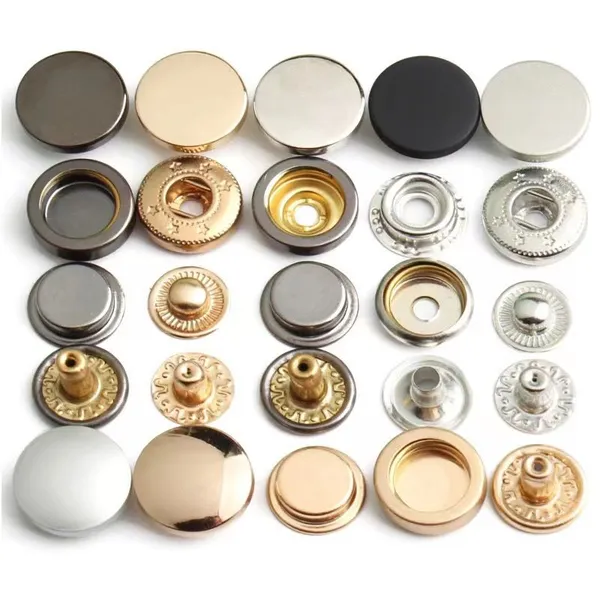
Factory Wholesale Hat Bag Clothing Press Snap Button Spring Snap Button Metal Snap ButtonsUS$ 0.03 - 0.06MOQ: 5000 Sets
-
Wholesale Plastic Round Coloured Snaps Button Press Fasteners for Baby Bibs/ Baby GarmentsUS$ 0.01 - 0.03MOQ: 50000 Sets
-
Custom EngravedCopper I Brass Metal Jeans Button Denim Clothes Jacket for Jeans DenimUS$ 0.01 - 0.03MOQ: 5000 Sets
-
17mm Open Hole Shank Button With Aluminum Nail With Logo for Jeans Jacket PantsUS$ 0.01 - 0.03MOQ: 5000 Sets
-
Eco-friendly Custom Size Plastic Snaps Plastic Snap Button for Baby Clothes, Baby BibsUS$ 0.01 - 0.03MOQ: 50000 Sets
-
12mm 15mm 17mm 20mm Four Parts Metal Brass Fastener Press Snap Button for Clothes JacketUS$ 0.03 - 0.06MOQ: 5000 Sets
-
Custom Logo Personalized High Quality Metal Press Snap Fastener Snap Buttons for Clothing Garments JacketUS$ 0.03 - 0.06MOQ: 5000 Sets
-
Custom Printing Round Press Spring Four Part Snap Button for Clothing Leather 405#17mmUS$ 0.03 - 0.06MOQ: 5000 Sets
-
OEM Garment Accessories Custom Baby Snap Button Press Metal Prong Pearl Ring Snap ButtonUS$ 0.01 - 0.03MOQ: 5000 Sets
-
Factory Stock Buttons Stainless Steel or Brass Material Colors Pearl Snap Button Prong Pearl Snap Button for Shirts ClothingUS$ 0.01 - 0.03MOQ: 5000 Sets
-
Resin Snap Buttons 9mm POM Heavy Duty Closure Parts for Baby Bibs and Textile Handmade Sewing ProductionNegotiableMOQ: 50000 Sets
-
13.8mm x 7.5mm Plastic Grommet Kit for Apparel and Garment Lacing, Lightweight and FlexibleNegotiableMOQ: 5000 Sets
-
Clear Plastic Eyelet and Washer Set Two‑piece Fastener for Tote Bags Canvas and Fabric Hole Reinforcement ApplicationsNegotiableMOQ: 5000 Sets
-
13.8mm x 7.5mm Clear Plastic Eyelet and Washer Set Durable Two‑part Hardware for Fabric Reinforcement and Bag Making ApplicationsNegotiableMOQ: 5000 Sets
-
Two‑Piece Plastic Grommet and Washer Set 13.8mm x 7.5mm Clear Hardware for Banner Craft Works and Light‑weight Textile ProductionNegotiableMOQ: 5000 Sets
-
Clear Plastic Eyelet and Washer Set 13.8mm x 7.5mm for Tarps, Banners, and Awning Fabric ReinforcementNegotiableMOQ: 5000 Sets