
 Business License
Spring Snap Button vs Prong Snap Button: Holding Force and Construction
A spring snap button and a prong snap button look similar once they sit on a finished garment and behave very differently the moment a load arrives. One holds through a spring that opens and closes inside the socket, while the other holds through metal claws that are folded into the fabric during setting. The choice between them changes how the closure fails, how the panel ages around the fixing, and how much holding force the garment still delivers after a season of washing. This guide sets out the construction of both, explains what a five claw snap button holding force figure actually measures, and shows where each style belongs.
The comparison runs from parts and setting method through load paths and testing, and closes with the material pairings that decide most orders in practice.
1. Spring vs Prong Snap Button: The Core Difference
The spring vs prong snap button comparison turns on one question, which is whether the closure grips itself or grips the fabric. A spring version carries a split spring inside the socket that opens around a bead on the stud and then closes behind it, so the two halves hold each other with no load on the panel at all. A prong version carries claws that are folded through the fabric and back onto a backing plate, so the closure holds by pinching the panel between two metal parts.
| Feature | Spring type | Prong type |
|---|---|---|
| Grip method | Split spring inside the socket | Claws folded into the fabric |
| Setting | Die rolls a post through the fabric | Die folds claws onto a backing plate |
| Fabric damage | A single post hole per half | Several piercings around a ring |
| Replacement | Cap and socket can be swapped in place | Removal leaves the fabric marked |
| Suits | Light to medium panels, repeat closures | Stable panels, permanent attachment |
Any spring vs prong snap button comparison comes down to this. That difference drives everything else, because a spring closure can be opened and closed thousands of times without wearing the fabric, since the fabric carries the fixing load alone. A prong closure loads the panel every time it is used, and the fabric around the piercing is the part that ages first.
2. Spring Snap Button Construction: Spring, Cap and Post
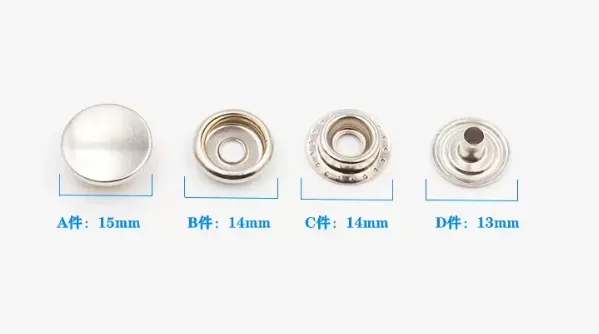
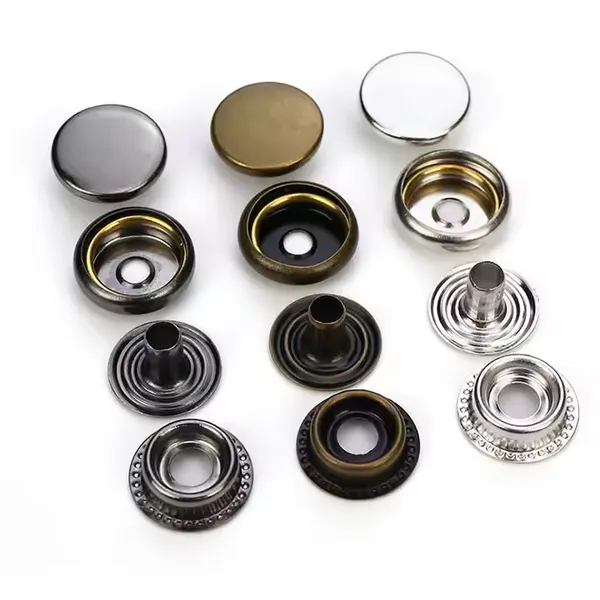
A spring snap button is built from four parts, and the spring is the one that decides its behaviour. The cap carries the visible face, the socket is pressed into the cap and holds a split spring of hardened wire or a pressed collar, the stud carries a rounded bead, and the post passes through the fabric and is rolled to clamp the half in place. The spring narrows at its mouth so that the bead has to force it open, and that interference is what produces the holding force.
The spring band is quoted as an opening diameter rather than as a force, because the force depends on the material and the heat treatment as well as on the geometry. A brass spring of the same opening as a stainless spring will release at a lower figure, and a spring that has been over-hardened can crack at the bend after a few hundred cycles. Moving the spring opening by about 0.1 mm is usually enough to shift the release force by several newtons without touching any other dimension.
The other three parts matter for durability rather than for feel. A post that is too short will not roll far enough to grip the panel, and one that is too long stands proud and catches on skin and on the wearer's clothing. Difei Button (Guangzhou) Co Ltd quotes the post against the measured stack thickness rather than against the cap diameter, because two garments can share a diameter and still need different posts.
3. Prong Snap Button Construction: Five Claw and Ring Snap Button Styles
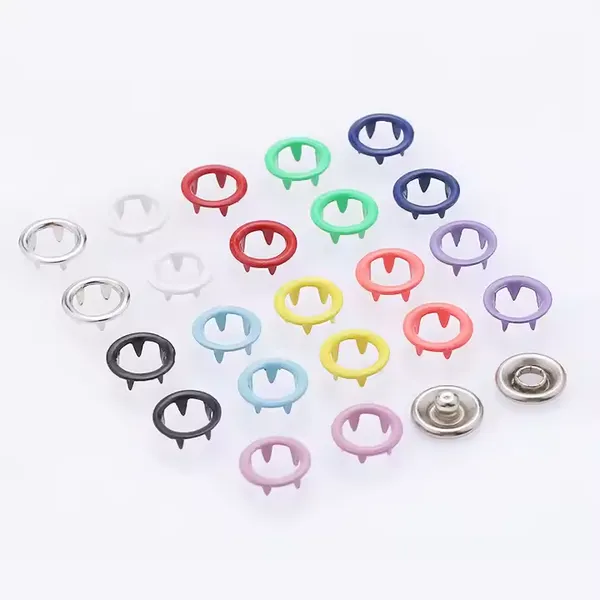
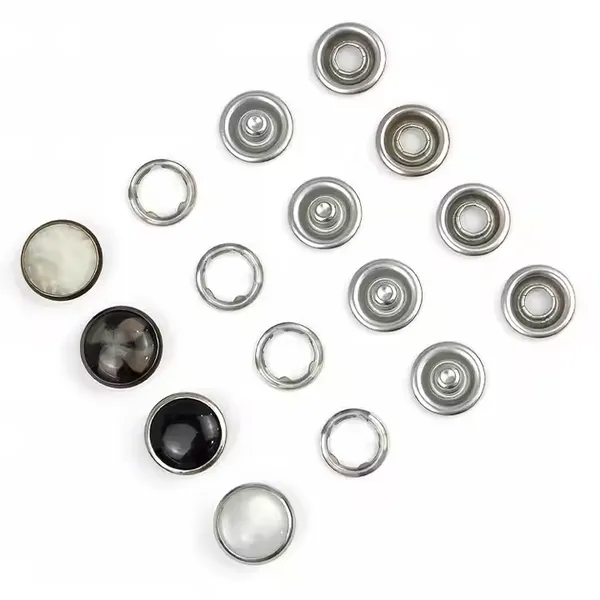
A prong snap button is built around a backing plate, and the number of claws on that plate defines the style. A five claw version spreads the load over five points arranged around a circle, which suits a panel that will see pull from more than one direction. A ring snap button uses a continuous rolled rim instead of separate claws, which spreads the load evenly and leaves a neater inner face. Both are set with a die that folds the metal over, and both are effectively permanent once set.
| Style | Fastening points | Load spread | Typical use |
|---|---|---|---|
| Five claw | Five separate claws | Good in all directions | Shirts, workwear, bags |
| Ring | Continuous rolled rim | Even around the circle | Thin panels, linings |
| Two prong | Two opposite claws | Strong along one axis | Straps, narrow panels |
The claw count is not the whole story, because claw length and gauge decide how much fabric the fixing can hold. A claw of 4 mm on a 0.6 mm plate behaves differently from the same claw count on a 0.9 mm plate, and a thicker plate resists deformation better under a repeated pull. Buyers comparing two quotations on claw count alone are comparing the least important number on the drawing.
Setting quality decides most field failures. A die that is worn or misaligned folds one claw less than the others, and the closure then fails from that single point. Verifying claw fold depth on a sectioned piece is worth more than any visual check on a finished part.
4. Five Claw Snap Button Holding Force: What the Numbers Mean
A five claw snap button holding force figure describes how much pull the setting can take before the closure separates from the fabric, and it is not the same as the release force of a spring closure. Release force measures how hard the wearer must pull to open the closure, while holding force measures how much the fixing resists being torn out of the panel. A buyer who asks for the wrong one of those two figures will approve a part that meets the number and still fails in use.
Typical holding force for a well-set five claw closure on a mid-weight woven panel sits between 60 N and 120 N, while the same closure on a light knit can drop below 40 N. The fabric, not the metal, sets the ceiling in most cases. A strong fixing on a weak panel does not fail by opening the claws, it fails by tearing the fabric out around them.
The figure also falls with repeated loading. A closure cycled 5,000 times can lose 15 percent to 25 percent of its initial holding force as the fabric around the claws stretches and the plate works slightly in its seat. Testing a part as set and testing the same part after cycling give two different numbers, and both belong on a specification.
5. Ring Snap Button vs Five Claw Snap Button: Load Path and Pull-Out
A ring snap button and a five claw snap button differ in where the load goes rather than in how much load they can take. Separate claws concentrate the load at five discrete points, so a pull along one axis loads two claws most and the other three lightly. A continuous rim spreads the same pull around the full circle, which lowers the peak stress on the fabric and usually raises the pull-out figure on a thin panel.
The even spread comes with a trade-off in setting. A rolled rim needs a die that closes progressively and a press with enough stroke control to form the roll without crushing it, while separate claws tolerate a wider machine window. A factory without stroke control will produce better results with claws, and one with good control can use the rim on panels that would tear around claws.
| Panel | Better load spread | Pull-out figure | Setting tolerance needed |
|---|---|---|---|
| Light knit, lining | Ring rim | 35 - 55 N | Close stroke control |
| Mid-weight woven | Either | 70 - 100 N | Standard |
| Heavy denim, canvas | Five claw | 110 - 150 N | Standard |
| Coated or laminated | Five claw | 60 - 90 N | Standard, sharp die |
Panel behaviour decides the choice more often than the closure does. A laminated panel with a film coating can crack around a rolled rim before the metal gives, and a light knit can pull away from separate claws before the plate deforms. Testing the actual panel with a trial setting is the quickest way to settle the question.
6. Measuring a Five Claw Snap Button Holding Force Figure
Measuring a five claw snap button holding force figure needs a stated method, because the number changes with the way the sample is held. A test that grips the fabric 20 mm from the closure reports a higher figure than one that grips it 50 mm away, since the longer span lets the panel stretch before the load reaches the plate. A test on a single layer reports differently from one on a seamed panel, and a test on a washed sample reports differently from one on a fresh panel.
The practical rules are few and worth writing down. Clamp the panel at a fixed distance from the closure, pull at a steady rate of about 100 mm per minute, and record the peak figure rather than the average. Test at least five pieces per batch, and test both a fresh sample and one put through a wash cycle, because the wash figure is the one that predicts field behaviour.
Difei Button (Guangzhou) Co Ltd keeps the clamp distance, the pull rate and the sample condition on the same sheet as the specification, so a buyer can reproduce the figure at goods-in instead of accepting a number without a method behind it.
7. Spring vs Prong Snap Button: Which Suits Which Material
Choosing between the two styles usually comes down to how often the closure will be opened and what the panel can tolerate. A spring version suits anything the wearer opens and closes daily, because the fabric carries just the fixing and never the working load. A prong version suits a panel that is stable, thick enough to hold a folded claw, and unlikely to need the closure replaced during the life of the garment.
| Garment or panel | Spring | Prong | Reason |
|---|---|---|---|
| Shirt placket | Yes | Workable | Frequent opening |
| Babywear | Yes | No | Smooth inner face needed |
| Denim jacket front | Workable | Yes | Stable heavy panel |
| Bag flap | Yes | Yes | Depends on lining |
| Thin lining or knit | Yes | No | Claws tear out |
Mixed construction is common and often the right answer. A garment can carry a prong fixing at the waistband, where the panel is heavy and the closure rarely moves, and a spring closure on the placket, where the wearer opens it many times a day. Specifying the two positions separately costs nothing and removes the compromise that comes from forcing one style across a whole garment. The spring vs prong snap button decision is therefore better made position by position than once for an entire range.
Difei Button (Guangzhou) matches the style to the position during sampling and quotes the two closures separately, so a brand can see the cost of each choice rather than a single blended figure.
8. Five Claw Snap Button Failure Modes and Prevention
A five claw snap button fails in four recognisable ways, and each one points at a different part of the process. Claws that unfold under load indicate a fold depth that is too shallow. Fabric that tears out around the claws indicates a panel too weak for the load or a claw that is too short. A plate that rotates in its seat indicates an under-set die or a panel that thinned during finishing.
A closure that separates at the bead points at a spring or stud problem rather than at the prong at all, which is why the two figures have to be measured separately. Difei Button separates the pull-out test from the release test on every batch, so a fault in one number cannot hide behind a healthy reading on the other.
Prevention sits mostly in the first article. Setting a trial panel and pulling it to failure shows where the closure gives, and that single test removes most of the guesswork. Checking fold depth on a sectioned piece confirms that the die is closing all five claws to the same depth, which a visual check on a finished part cannot show.
A workwear maker saw repeated returns when closures rotated in a coated panel after about 30 washes. The cause was a 0.4 mm fold depth against a 0.7 mm target, and the die had drifted over a long production run. Resetting the die and adding a fold depth check every 500 pieces ended the problem without changing the part.
9. Frequently Asked Questions
9.1 Should I choose a spring or a prong closure for a shirt?
Choose a spring closure when the shirt will be opened and closed often, because the fabric then carries the fixing rather than the working load. A prong closure suits a heavy placket that is rarely unfastened and where a thin metal plate on the inner face is acceptable against the body. For most shirts the spring version is the safer default, and a prong fixing belongs at the waistband or on a bag flap where the panel is stable and thick.
9.2 What affects a five claw snap button holding force figure?
Three things move the figure most, and the fabric leads the list, because a heavier woven panel holds far more pull than a light knit of the same closure and the panel usually tears before the metal gives way. Fold depth on the claws sets how evenly the load spreads, and a shallow fold concentrates the pull on one or two points. Test method matters as well, since clamp distance and pull rate shift the reported figure by a wide margin. A single number quoted without the panel and the test conditions behind it tells a buyer very little about how a batch will behave in service.
9.3 Is a ring snap button stronger than a five claw version?
Neither is stronger in every case, and the panel decides which wins. A continuous rim spreads the load around the full circle, so it usually gives a higher pull-out figure on a thin or flexible panel. Separate claws bite deeper into a heavy fabric and resist a pull along one axis well, which suits thick woven and coated panels. The setting die matters as much as the style, since a poorly formed rim fails sooner than a well-formed set of claws.
9.4 How do I test holding force before approving a batch?
Clamp the panel at a fixed distance from the closure and pull at a steady rate, then record the peak figure on at least five pieces. Repeat the test on a sample that has been through a wash cycle, because the washed figure is the one that predicts how the closure behaves in service. Ask for the clamp distance and the pull rate to be written on the report, since a figure without a stated method cannot be compared with the sample you approved earlier.
Recently Posted
-
Buttons for Bedding, Pillow Covers and Home Textiles
September 28, 2026A home textile button lives a harder life than a garment closure, because it is unfastened to wash and refastened when the item go Read More
 -
Specifying Button Tolerances on a Purchase Order
September 28, 2026Two shipments can both match the drawing and still fail to work together, because a nominal figure says nothing about where inside Read More
 -
Ordering Custom Badges: Tooling, Backing and Approval Steps
September 28, 2026A custom metal badge order fails for one of three reasons, and none of them is the price of the metal. The artwork is approved bef Read More
 -
Shank Button vs Flat Button: Matching Construction to Garment Weight
September 28, 2026The shank button vs flat button decision looks like a styling question and behaves like a structural one, because the two parts ha Read More

Contact Us
Recommended Products
-
 Clothing Accessories Lead Free Brass Metal Ring Prong Snap Button With 4 Parts for Infant Baby Clothes Baby BibsUS$ 0.01 - 0.03MOQ: 5000 Sets
 -
Brass Metal Stainless Steel Material Ring Prong Snap Button With 4 Parts Lead Free & Nickel Free for Infant Baby Clothes Baby Bibs Baby SuitsUS$ 0.01 - 0.03MOQ: 5000 Sets
-
Metal Grommets Eyelets Gold Eyelet for Bag Shoes and Garment AccessoriesUS$ 0.01 - 0.03MOQ: 5000 Sets
-
Cheap Price Custom Jeans Button Metal Custom Logo Metal Button for JeansUS$ 0.01 - 0.03MOQ: 5000 Sets
-
Factory Wholesale Hat Bag Clothing Press Snap Button Spring Snap Button Metal Snap ButtonsUS$ 0.03 - 0.06MOQ: 5000 Sets
-
Wholesale Plastic Round Coloured Snaps Button Press Fasteners for Baby Bibs/ Baby GarmentsUS$ 0.01 - 0.03MOQ: 50000 Sets
-
Custom EngravedCopper I Brass Metal Jeans Button Denim Clothes Jacket for Jeans DenimUS$ 0.01 - 0.03MOQ: 5000 Sets
-
17mm Open Hole Shank Button With Aluminum Nail With Logo for Jeans Jacket PantsUS$ 0.01 - 0.03MOQ: 5000 Sets
-
Eco-friendly Custom Size Plastic Snaps Plastic Snap Button for Baby Clothes, Baby BibsUS$ 0.01 - 0.03MOQ: 50000 Sets
-
12mm 15mm 17mm 20mm Four Parts Metal Brass Fastener Press Snap Button for Clothes JacketUS$ 0.03 - 0.06MOQ: 5000 Sets
-
Custom Logo Personalized High Quality Metal Press Snap Fastener Snap Buttons for Clothing Garments JacketUS$ 0.03 - 0.06MOQ: 5000 Sets
-
Custom Printing Round Press Spring Four Part Snap Button for Clothing Leather 405#17mmUS$ 0.03 - 0.06MOQ: 5000 Sets
-
OEM Garment Accessories Custom Baby Snap Button Press Metal Prong Pearl Ring Snap ButtonUS$ 0.01 - 0.03MOQ: 5000 Sets
-
Factory Stock Buttons Stainless Steel or Brass Material Colors Pearl Snap Button Prong Pearl Snap Button for Shirts ClothingUS$ 0.01 - 0.03MOQ: 5000 Sets
-
Resin Snap Buttons 9mm POM Heavy Duty Closure Parts for Baby Bibs and Textile Handmade Sewing ProductionNegotiableMOQ: 50000 Sets
-
13.8mm x 7.5mm Plastic Grommet Kit for Apparel and Garment Lacing, Lightweight and FlexibleNegotiableMOQ: 5000 Sets
-
Clear Plastic Eyelet and Washer Set Two‑piece Fastener for Tote Bags Canvas and Fabric Hole Reinforcement ApplicationsNegotiableMOQ: 5000 Sets
-
13.8mm x 7.5mm Clear Plastic Eyelet and Washer Set Durable Two‑part Hardware for Fabric Reinforcement and Bag Making ApplicationsNegotiableMOQ: 5000 Sets
-
Two‑Piece Plastic Grommet and Washer Set 13.8mm x 7.5mm Clear Hardware for Banner Craft Works and Light‑weight Textile ProductionNegotiableMOQ: 5000 Sets
-
Clear Plastic Eyelet and Washer Set 13.8mm x 7.5mm for Tarps, Banners, and Awning Fabric ReinforcementNegotiableMOQ: 5000 Sets